Hello friends! I'm Jennifer from The Blessed Teacher! I teach the third grade gifted cluster at my school. A few years ago, my district moved to the cluster model. Instead of pulling gifted kids out for instruction, all of the kiddos at our grade level that have been identified as gifted learners are in my room. I have 28 stud7 of my students are identified as gifted. One of the things I have struggled with is how to keep these kiddos challenged when we are covering material that already know. Enter extension menus.
Extension menus offer an opportunity to differentiate learning and to reach different learning styles. I offer all of my students the opportunity to work on a menu. In fact, there have been many times that we get to a concept that a good chuck of my students have already mastered, not just my gifted kids.
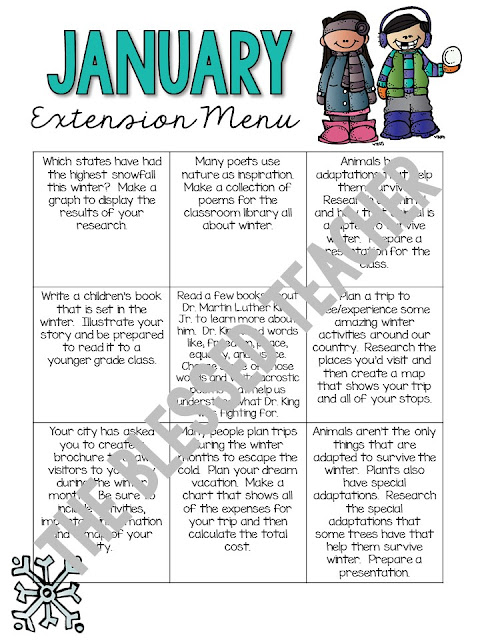
I created this extension menu for the month of January and I wanted to share it with you Hello Sunshine readers! The extension menu has choices for ELA, Math, Science and Social Studies topics that we cover or have covered in third grade. I hope that you find it useful! Just click on the picture to get to the free download!
Showing posts with label free download. Show all posts
Winter Extension Menu
Let it Snow! Books to share on a Snowy Day.
Let it Snow!
One
of the reasons I live in the Arizona desert is the snow-free winters. I don’t
hate snow, I just don’t want to live with it. But these snow-free winters mean
a lot of our students have never seen snow and that’s a shame because the snow
can be a lot of fun.
So….
I use books to bring the fun of snow into the classroom without living in the cold and mess!
Snowflake Bentley by Jacqueline Brigg, (the link takes you to Snowflake Bentley's official website) I saved my favorite book for last. This beautiful book was introduced to me by a good friend who lives in Vermont. One year she sent me the book along with a snowflake print from Bentley's collection as a Christmas gift. I instantly fell in love with the book and used it in my classroom every year.
You can download these free activities to go along with this very special book.
Thomas’ Snowsuit by Robert Munsch, Very funny book about the difficulties of putting on a snowsuit. (You can listen to the author the book aloud on his website!)
The Story of Snow by Mark Cassino and Jon Nelson, Ph.D. This link will take you to a free teacher's guide!
Snow
by Cynthia Rylant, a young girl enjoys a day in the snow. this link will take you to a brief activity guide for the book.
Snow Day by Lester Laminack, This delightful story puts a twist on "Snow Day."
A Perfect Day by Carin Berger, This book paints a picture of a perfect day in the snow.
Snowballs
by Lois Ehlert In this beautiful books students will enjoy the collages used to make the pictures. The link goes lesson ideas for this book.
Over and Under the Snow by Kate Messner, A wonderful informational text about life over and under the snow. The link will take you to lesson ideas.
Blizzard
by John Rocco This book is based on true experiences by the author. The link will take you to a book trailer.
The Missing Mitten Mystery by Steven Kellogg, After a day of playing in the snow a little girl discovers one of her mittens is missing! Where could it be? The link goes to a site with free lesson ideas.
Polar Bears by Gail Gibbons Another wonderful book filled with interesting facts about these giants of the north.
Owl Moon by Jane Yolen In this nighttime adventure a girl and her father go searching for owls on a moonlit winter night. The link takes you to lesson plan suggestions.
You can download these free activities to go along with this very special book.
I hope you're having a wonderful winter with your students. Maybe a few of these books will find their way into your snowy lessons.
Labels:
Debbie Crockett
,
free download
,
snow
,
snow day
,
Snowflake Bentley
,
winter
Organizing Lesson Plans, Materials, and Center Activities for the Year
Happy August! All this month, the Hello Sunshine collaborators will be sharing some great organizational tips and tricks for your classroom! I'm kicking off this month's theme by sharing just a few ideas for organizing classroom resources, including my center buckets! There's a freebie for organizational labels in here, too, so make sure you read the entire post so you can download them and use them in your classroom!
When I first started teaching, I "organized" (and I use that term loosely) my daily lesson plan materials by putting all of my copies, books, and materials into a different manila file folder for each day of the week. It wasn't the most efficient organizational strategy in the world - the folder wasn't big enough to hold all of the day's materials and it was difficult to pull items out without bringing the rest of the papers with it. So one summer, I decided enough was enough and I invested in the All-Purpose Teacher's Organizer from Lakeshore. I can't say enough good things about this product. It comes with 5 bins, one for each day of the week, with 5 file folders to organize your daily materials. This meant that I could have one separate folder of items for Reading, Writing, Math, Science, and Social Studies! No more mixed up papers or materials falling out of folders. This thing keeps everything in order! And, if you're wondering, no I am not getting any sort of compensation for telling you about this organizer... ha! I just love it that much!!
ORGANIZING LESSON PLANS & DAILY MATERIALS
When I first started teaching, I "organized" (and I use that term loosely) my daily lesson plan materials by putting all of my copies, books, and materials into a different manila file folder for each day of the week. It wasn't the most efficient organizational strategy in the world - the folder wasn't big enough to hold all of the day's materials and it was difficult to pull items out without bringing the rest of the papers with it. So one summer, I decided enough was enough and I invested in the All-Purpose Teacher's Organizer from Lakeshore. I can't say enough good things about this product. It comes with 5 bins, one for each day of the week, with 5 file folders to organize your daily materials. This meant that I could have one separate folder of items for Reading, Writing, Math, Science, and Social Studies! No more mixed up papers or materials falling out of folders. This thing keeps everything in order! And, if you're wondering, no I am not getting any sort of compensation for telling you about this organizer... ha! I just love it that much!!
ORGANIZING SCHOOL SUPPLIES
Organizing school supplies is always an issue that can easily get out of control... just ask any teacher! Or, just look at this plastic bin of mine after families donated supplies at Meet the Teacher Night:
Can you say... hot mess?!? Every time I needed a supply I'd have to go digging for buried treasure; and ain't nobody got time for that! I decided to purchase a big 5-drawer Sterilite container (about $25 at Wal-Mart) and sorted all of my extra supplies into each drawer. It made my life so much easier to have everything organized and in its place!
My students don't have access to this drawer - this is just where I keep my extra donated supplies and then I grab items from the drawers as needed. We do community supplies in my classroom; and each table has their own bucket of scissors, glue bottles, and glue sticks in a different colored caddy. Then, whenever they need them, one student will grab their individual table buckets. It makes things so much easier to have them all in one easy location for the students to get on their own.
ORGANIZING CENTER ACTIVITIES
Next up, let's talk center organization. I have so many amazing resources that I have both made myself and purchased from TPT. Most of them have lots of pieces to them: cards, spinners, recording sheets... the list goes on! When I first attempted to organize them, I used big manila envelopes and put all of the pieces inside. However, when I put all the envelopes in a big plastic bin, they'd fall and slide to the bottom and were slightly too big and too tall to fit nicely into the bucket. It got frustrating to look through and pick up each one that had fallen on top of one another and it just didn't work for me. Finally, I figured out a great way to organize all of my center activities:
As pictured above, here are the materials I used to get everything started: plastic hanging file folder bin, Post-It sticky tabs, hanging file folders, Ziploc gallon-sized bags, skinny Sharpie markers.
Here's what I did to put it all together:
1. Sort center activities in whatever way helps you organize them the most. In my case, I chose to sort them by concept/theme (sight words, sentence building, October/Fall, etc.). I got to work putting together the hanging file folders first. I filled in each tab with the learning concept so that I would know exactly where to find centers that matched each standard.
2. Get one of the Ziploc gallon bags. This is what you'll use to store each center so the parts and pieces don't get away from you. I put the recording sheet (if it had one) and any game pieces or cards that went along with it.
3. Use a Post-It sticky tab to write the name of the center, and the creator's name, if you'd like. For this beginning sounds center, which can be found in Cara Carroll's The Bus Stops Here {Math and Literacy Centers} pack, I wrote the name of the activity and put a little "CC" at the end so that I knew it was from her store. This is helpful in case you ever find yourself looking for a specific author's center activity. I used a skinny Sharpie marker so that I could fit as much information on the tab as I needed to without it looking too sloppy.
Once you've done that... you're finished! Just pop the finished bag into the correct standard/themed tabbed folder and you've got yourself a gloriously organized tub of centers.
I love that these tubs have lids so that I can stack them anywhere I need to. I've got two of them so far, but both are getting pretty full! It's almost going to be time for me to make a third tub of centers!
ORGANIZING WITH LABELS
Finally, one of the ways teachers most love to show their organized selves off in the classroom is by using cute labels! A label added to any bin or bucket is the perfect way to add a cute and functional way to organize materials, supplies, and resources. Here's an example of what my labeled bins look like in my classroom:
You can grab these labels and more for FREE in my TPT store! Just click on the picture below to download!
Keep coming back all month for more classroom organization ideas!
Kicking off a New School Year With Kindergarten Read Alouds
We all know the beginning of the school year is full of excitement, adjustment, and exhaustion. Our classes and days can be unpredictable and it takes some time to get students acclimated to classroom routines and procedures. Even if you have a basal curriculum, chances are you don't start teaching from it right away as there are pre-assessments, community building activities, and teaching routines to attend to. If you want to kick off the school year in a fun, meaningful way; and aren't sure where to start; one of the best and easiest resources to use at the beginning of the year are themed read alouds! I've got some great book recommendations for Kindergarten that can help get your students excited and feel more at ease for the upcoming year!
Utilizing picture books in the classroom is such a vital resource for your students. Reading stories aloud creates student interest in reading, introduces important story elements, and increases reading comprehension. For your early kindergarten learners, it also teaches skills such as sitting and listening appropriately to a story.
Here are some suggestions for great read alouds for the beginning of kindergarten:
Utilizing picture books in the classroom is such a vital resource for your students. Reading stories aloud creates student interest in reading, introduces important story elements, and increases reading comprehension. For your early kindergarten learners, it also teaches skills such as sitting and listening appropriately to a story.
Here are some suggestions for great read alouds for the beginning of kindergarten:
Book Titles & Authors from top left to bottom right: Clifford's First School Day by Norman Bridwell, Miss Kindergarten Gets Ready for Kindergarten by Joseph Slate and Ashley Wolff, The Night Before Kindergarten by Natasha Wing, Kindergarten ROCKS! by Katie Davis, The Kissing Hand by Audrey Penn, Kindergarten, Here I Come! by D.J. Steinberg and Mark Chambers, Countdown to Kindergarten by Allison McGhee and Harry Bliss, and David Goes to School by David Shannon
I've used every single one of the books pictured above and my students absolutely loved them! They were so excited when they found something in the book that "was the same as our class". The thing I love about these themed books is that you can literally create any activity you want to to go along with the story. Here are some examples of things I've done in my classroom:
The Kissing Hand
The Kissing Hand is a great book to help ease your kindergarteners' fears about starting school. On the first day, read the story aloud and then have your students create this poem craftivity. Students will trace their hand, cut it out, and draw a heart in the middle. You could also use heart stickers for a simple decoration. Then, glue the hand and poem onto a piece of construction paper and you've got an adorable keepsake from the first day of school. Click on the picture below to download the poem for free!
Miss Bindergarten Gets Ready for Kindergarten
This book tells the story of how a teacher gets ready for kindergarten. After reading the story, I have my students complete this activity sheet for students to draw a picture of how they got ready to come to kindergarten. When I model my version to the class, I make a point to talk about how many colors and details I am adding to my picture. It also provides a line for name writing practice, an essential kindergarten skill.
Clifford's First School Day
This is a simple story response sheet you can use with your students. By completing this activity, kindergarteners will have a chance to practice skills such as: name writing, letter tracing, drawing pictures to match labeling words, learning the name of their school, and story retelling by illustrating.
One thing I've learned from teaching kindergarten for 6 years is that they need LOTS of space to write and draw. Sometimes, when I create an activity, an 8 1/2x11 piece of paper just doesn't cut it. I use a ton of legal size and 11x17 paper, especially during the first half of the year. Thankfully, our school copier is set up to be able to print and copy this size - it's an easy fix to make one of the trays use different sizes of paper in the settings! Try it out! You'll thank yourself for it later when your little kinder babies are writing gigantic letters that just don't fit on a skinny little line.
With that being said, I created the Clifford's First School Day response sheet on 11x17 paper. However, since it is saved as a PDF, you can print it on 8 1/2x11 paper - that is actually the default setting. If you'd like to print it out on 11x17 (which I highly recommend), here are the steps you follow:
1. Click "File" --> "Print"
2. Click "Page Setup" (usually at the bottom of the dialog box)
3. Click "Paper Size" and change it to Tabloid or 11x17 (may be different depending on if you are using a Mac or a PC)
4. Click "OK"
5. Click "Print"
And voila! You have a big workspace for your little learners.
But don't worry, you don't HAVE to print it on 11x17... it's just an option!
Click on the picture below to download the story response sheet for free!
What are some of your favorite read alouds for the beginning of the year? Share in the comments below, regardless of grade level!
Labels:
back-to-school
,
books
,
craftivity
,
free download
,
kindergarten
,
reading
Mindsets in the Classroom WRAP UP!
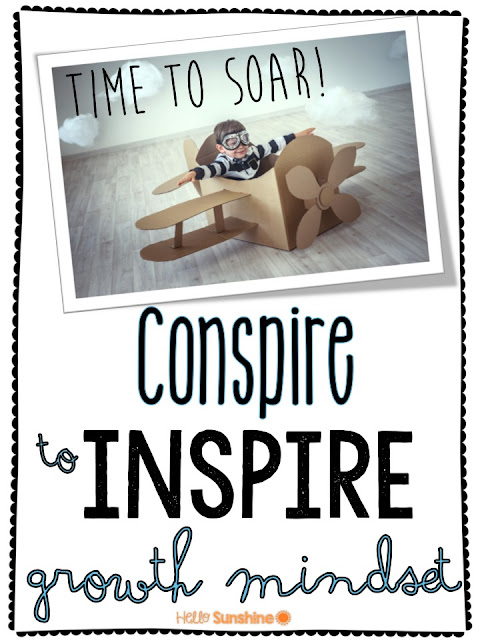
Are you ready? Let's do this! Mary Cay Ricci makes it infinitely clear that although we obviously cannot control many variables in our students' lives, we certainly possess the ability to make a meaningful impact on them in the classroom to inspire a growth mindset! We can conspire to inspire our students by encouraging them to reach small goals everyday to boost their confidence and grow their growth mindset muscles! As we wrap up our book study we would like to thank you so much for joining us, and we hope you have enjoyed this Mindsets In the Classroom adventure! Below is a free poster for you to print and post near your work area in your classroom to remind you to help your kids soar!
Conspire to inspire growth mindset!
•Value effort, persistence, and perseverence
•Praise effort over intelligence
•Small goals & wins boost confidence
•School improvement plans should include growth mindset goals/focus
•School staff meetings should include growth mindset talk/focus
•Parent-Teacher conferences should include education/talk of growth mindset
•Classrooms should be non-threatening, and fear free of embarrassment from mistakes or failures - in fact they should be celebrated for evidence of trying and working hard to learn & grow!
Conspire to inspire growth mindset!
•Value effort, persistence, and perseverence
•Praise effort over intelligence
•Small goals & wins boost confidence
•School improvement plans should include growth mindset goals/focus
•School staff meetings should include growth mindset talk/focus
•Parent-Teacher conferences should include education/talk of growth mindset
•Classrooms should be non-threatening, and fear free of embarrassment from mistakes or failures - in fact they should be celebrated for evidence of trying and working hard to learn & grow!
Thanks again for reading with us this summer!
Mindsets in the Classroom Ch. 2: Building a Growth Mindset School Culture
Our Summer book study with Mindsets in the Classroom has kicked off with a bang! We have already reached Chapter 2 and we are so thrilled to have all of you linking up with us to share your thoughts. We hope you will continue to join us all month long!
Let's dive in, shall we?
Chapter 2 immediately gives us some practical ideas for implementing a growth mindset culture in our schools.
Let's dive in, shall we?
Chapter 2 immediately gives us some practical ideas for implementing a growth mindset culture in our schools.
Mary Cay Ricci writes, "The first step along the path to building a growth mindset culture is to begin to build a school culture that values intellectual growth with a staff who has internalized the belief that intelligence can be cultivated."
How can we accomplish this? By implementing 7 steps that will help lead teachers, staff, students, and parents to have a growth mindset:
1. Professional Development for All School Personnel
Before beginning growth mindset professional development, it is first important to determine what belief systems are held by staff at the present time. This will help gauge what they know and believe to be true about growth and fixed mindsets before they are taught new information about each one. Interestingly enough, when the author surveyed the staff she was visiting, the majority of less-experienced teachers tended to have a growth mindset while experienced teachers tended to have a fixed mindset. Kind of telling on how a teacher's mindset tends to change so drastically after continuing in the teaching profession for a few years.
Surveying your staff can be a quick and easy thing: If you're interested in getting this kind of discussion started at your school, I've created a freebie for you that you can use with your staff when introducing a growth mindset culture. Just click on the picture below to download!
2. Educate staff about malleability of the brain.
Many people believe that intelligence is a permanent attribute that we are born with and it can be very shocking to find out the opposite. One discussion you could have with your staff is to pose the question, "If you were given instruction, time, and had motivation, could you improve at a given skill?" This can get everyone talking and explain the concept of brain malleability on a relatable level.
You can also introduce teachers to the idea of growth mindset by talking about how one's emotions can be changed based on one's thinking, attitude, and behaviors.
Studies have shown that happiness and empathy can be practiced and developed!
Ricci gives an example of this by writing about a new curriculum called MindUP, which was developed by The Hawn Foundation and Scholastic in 2011. They believe we can train our brain to have an optimistic perspective. My Kindle version of the book had a link to the MindUP page where they had this fascinating video on the MindUP program according to teachers. Having their students participate in things like peaceful breathing exercises and brain breaks seemed to help their students remain calm, even in stressful situations like testing. Check it out here:
3. Educate staff about praise for students.
Educators must be more aware of the way we praise students! Praise them for their hard work and effort - not just about how smart they are. Kiddos just want to be noticed and acknowledged!
4. Educate teachers about the brain.
Many people have not been educated about how the brain works and how it relates to our learning. Ricci sums it up in a simple way for you to teach it to your staff: "Neurons make new connections when you learn something new. These connections become stronger with practice and effort."
In order to strengthen these neural connections, teachers need to consistently make connections to prior knowledge and experiences. I've found that when I connect my students' prior knowledge while introducing a new concept, it is easier for them to stay engaged and pay attention when you are talking about something that has related to their lives in the past.
I love the imagery used when describing a new neural pathway: it's like walking through a new, unexplored forest for the first time. The more you use it, the clearer the path becomes. It's such a great visual for what happens when students begin to have a deeper understanding of the concepts taught!
What are some ways that you like to connect prior knowledge and experiences with your students? We'd love to hear your ideas and comments below!
5. Teach students about the brain.
Students must understand that intelligence is constantly changing based on effort, persistence, and motivation.
This part was interesting to me. I never would have thought about teaching the kids about the brain in order to achieve a growth mindset. We always think of changing mindsets within ourselves, but to get your whole school on the same path, it's a great idea to teach our students WHY. To do this, the author suggests that lessons should be designed to teach kids about the brain's broader involvement with their five senses, physical activity, and everyday actions. This is so perfect to get kids moving, thinking, and engaged in the classroom. Think about how websites like GoNoodle have revolutionized our classrooms by promoting brain breaks and movement. You could introduce the concept of how intelligence can be changed by promoting the use of their five senses and physical activity and then do a GoNoodle brain break with your kiddos like "Brainercise with Mr. Catman" as a fun example! (And if you've never seen it, it's a man with a giant cat mask in a classroom. Challenging students to do difficult brain exercises. And it is amazing. Haha.) Look for this icon when you head to GoNoodle!
6. Educate Parents
We all know that a huge key to increasing school culture is parent involvement and buy-in. However, it's often an aspect that can be overlooked since parents aren't at school the entire time like teachers and students are. Involving parents in a growth mindset discussion can help them view their children in a different light when it comes to intelligence or in how they speak to their kids.
7. Monitor, Evaluate, and Review School Protocols
Once your school has spent a good amount of time and training towards building a growth mindset, you can begin to evaluate how well your school and staff are doing. One idea you can implement is to establish "Look-fors"; student/teacher behavior when you walk through any room in the building. PLC's are also a great way to help teachers think and reflect on their mindsets with their individual teams and grade levels. You can give them time to discuss how they think they have changed or stayed the same in their mindset thinking throughout the year and how it has helped or hindered them.
The last story sort of saddened me because it is something we see all the time in schools and I'm sure we all have been guilty of this type of thinking at one time or another. A student wanted to be placed in an honors level English course to increase her love of literature and the department chair denied her request without even meeting the student simply based on the child's test scores. When we talk to parents about their student when they do not meet certain goals or criteria, it's important to try and phrase things in a way that doesn't say "we don't think your child is smart enough". If a student is showing self-motivation and a desire to want to do something, that goes a long way in determining whether or not they might be successful at something, regardless of previous test scores. We as teachers never want to make our students think that they are not smart enough. How devastating to a child! Having a growth mindset helps with this positive thinking and takes into account student motivation. Now, it doesn't mean that every parent or student is going to get what they want in these situations, but at least giving them a fair shot is all anyone can ask.
So what's the take away?
If this is something you find yourself strongly believing in, begin talking with your administrators and instructional coaches about planning professional development time to teach about growth mindset to build school culture. Use the free planning pages to get things started!
What were the things that stood out to you from Chapter 2? Is this something you are inspired to do at your school?
Subscribe to:
Posts
(
Atom
)